
Objective: this article explains, in plain numbers, what STI testing actually costs in the United States in 2026, why cost keeps people from testing, and exactly where an uninsured person can go — free, low-cost, or self-pay — before you pick up the phone or open a checkout page.
Affiliate disclosure: This article contains an affiliate link to STDcheck.com. If you use it, PharmDecoded may earn a commission at no additional cost to you. That relationship does not change what we report below, and you are never required to use the linked service — the free and low-cost options in this article are listed with equal weight.
Educational note: This article explains public data and general options. It is not medical advice, a diagnosis, or a recommendation for a specific test. A clinician can help you choose the right test, timing, and follow-up for your situation.
“STD testing without insurance” sounds like it should have one simple answer. It doesn’t — because the real question underneath it is really three questions: how much will this cost, how fast can I get it done, and does the price actually match what I’m getting. This article answers all three with current numbers, not guesses.
A very short history of STD testing
Sexually transmitted infections aren’t new, but reliable testing and treatment are relatively recent. Syphilis and gonorrhea were described for centuries before anyone could do much about them beyond quarantine and folk remedies. That changed fast in the 20th century.
Penicillin was first used to treat and cure syphilis in 1943, turning a disease that had disfigured and killed people for generations into something curable with a single class of antibiotics. Diagnostic testing improved through the 1960s, and in 1972 the CDC published its first recommended treatment schedule for gonorrhea. A decade later, in 1982, the CDC issued its first comprehensive national Treatment Guidelines for STDs — the direct ancestor of the guidance clinicians still use today. Those guidelines have been revised roughly every few years since (most recently in 2021) as bacteria evolved resistance to older antibiotics and testing technology got faster and more accurate.
What used to require a lab visit, a wait of a week or more, and a return trip for results can now often be done with a same-day blood draw and results in one to two days — or, for some infections, a kit you collect at home yourself. The science moved fast. Figuring out who pays for it, and how much, has moved a lot slower.
The numbers today: STIs are still common, even as cases fall
The CDC’s most recent national data — provisional 2024 figures, published September 2025 — show reported cases of the three infections it tracks nationally in a multi-year decline: the second year in a row for chlamydia and syphilis, and the third year in a row for gonorrhea.
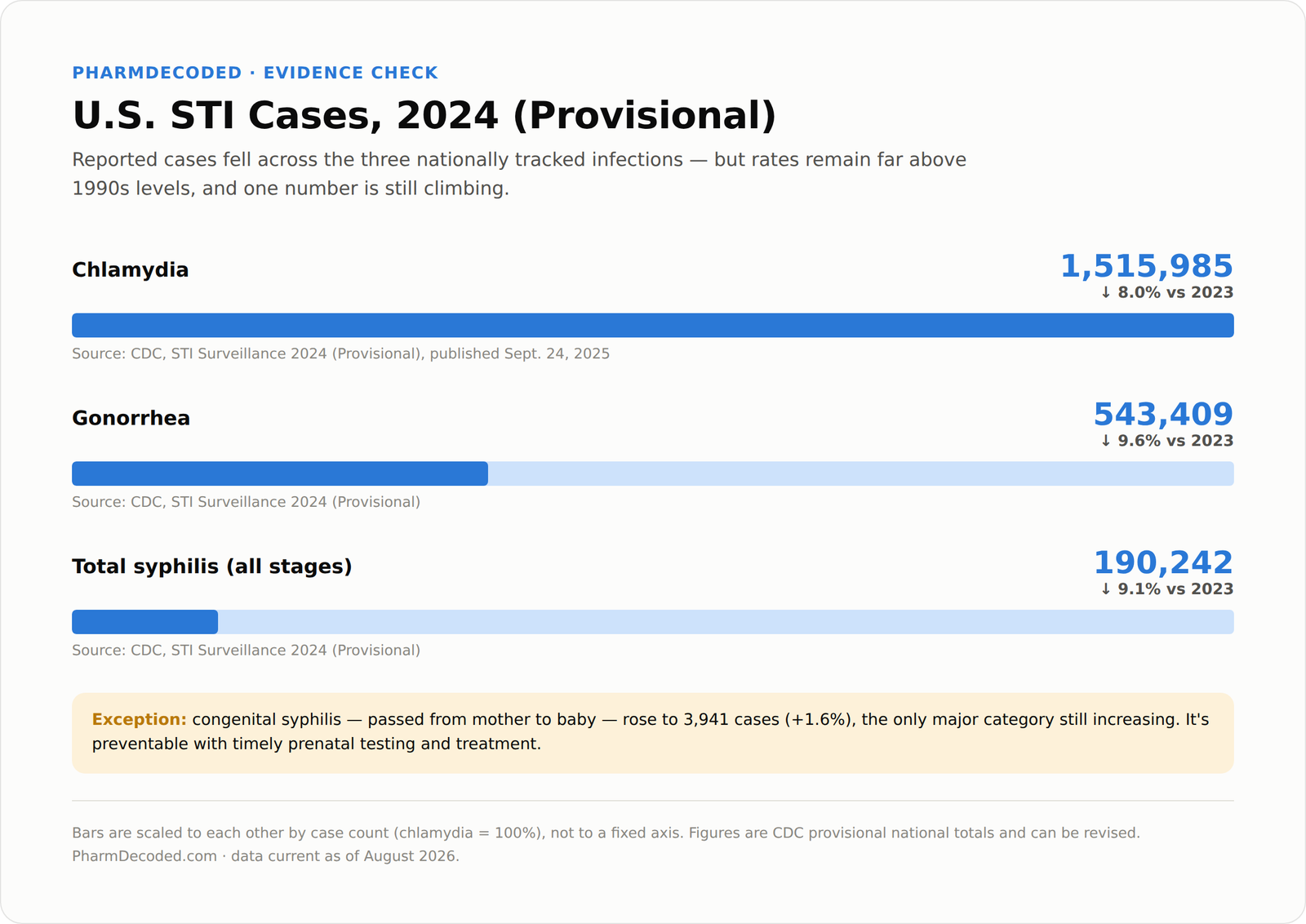
That’s over 2.2 million reported cases of just these three infections in one year — and reported cases are a floor, not a ceiling, since many infections (chlamydia especially) cause no symptoms and go undiagnosed. The one number moving the wrong direction is congenital syphilis, passed from a mother to her baby during pregnancy, which rose to 3,941 cases. It’s also one of the most preventable outcomes on this list: timely prenatal testing and treatment stops it.
The CDC’s testing guidance is built around this reality. Everyone ages 13–64 should be tested at least once for HIV. Sexually active women under 25 should be screened annually for chlamydia and gonorrhea, as should older women with new or multiple partners. Men who have sex with men are generally advised to test every three to twelve months depending on risk. Pregnant women are tested for syphilis, HIV, and hepatitis B and C early in pregnancy. None of these recommendations mention insurance status, because the biology doesn’t care whether you have a health plan.
Why cost gets in the way
An estimated 27.1 million Americans — 8.0% of the population — had no health insurance at any point in 2024, according to Census Bureau data. The rate is uneven: young adults ages 19–25 are uninsured at 14.5%, nearly double the overall national rate, per KFF analysis of federal survey data — largely because this is the age band where people age off a parent’s health plan before employer coverage typically picks up, and it overlaps heavily with the ages the CDC recommends annual chlamydia and gonorrhea screening for sexually active people. Coverage gaps are also wider in the 10 states that still haven’t adopted Medicaid expansion.
None of that means testing is out of reach without a health plan. It means the path looks different, and it’s worth knowing what each path actually costs before you pick one.
What testing actually costs, by route
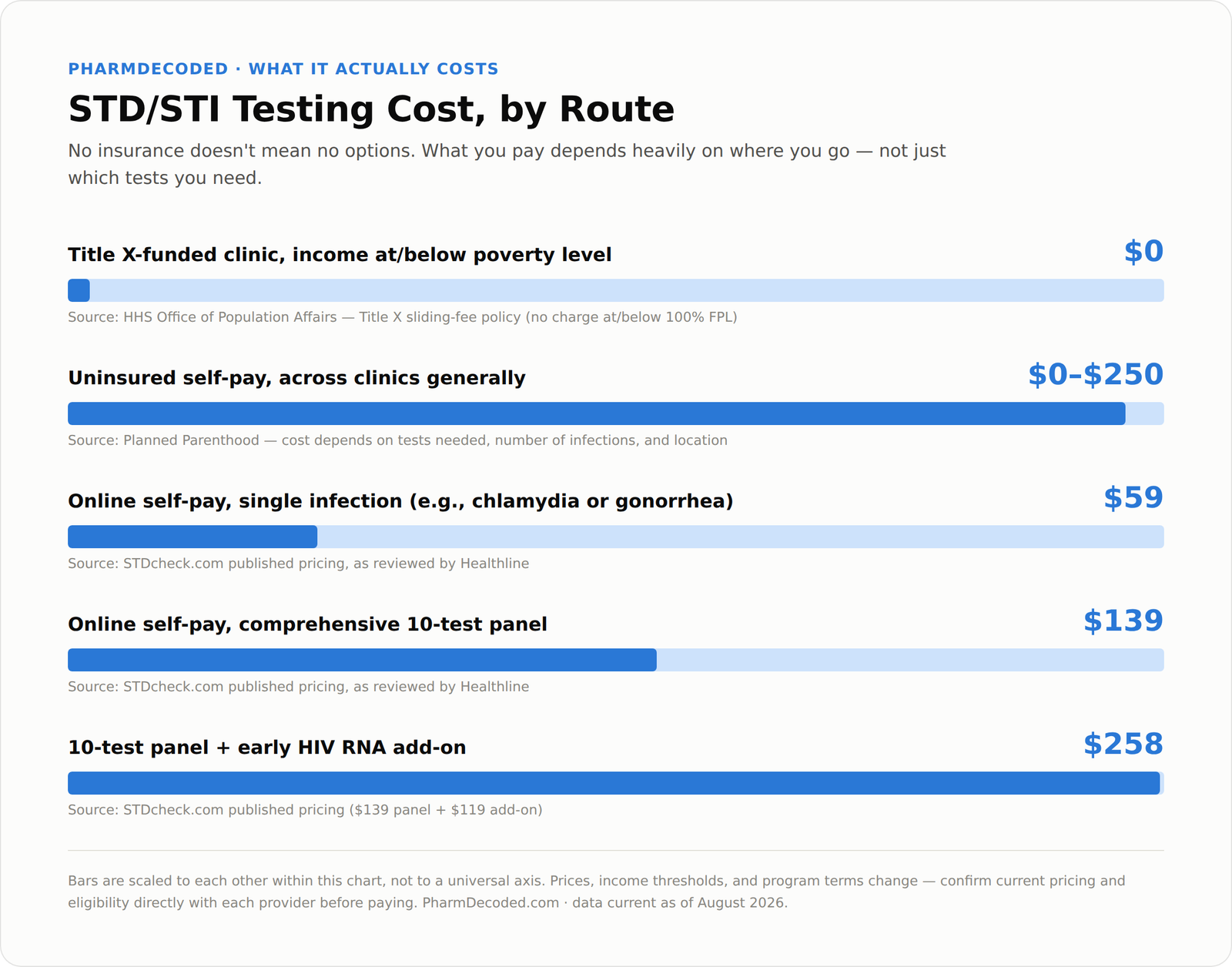
- Title X-funded family planning clinics charge nothing to anyone at or below the federal poverty level, and a discounted sliding-scale fee up to 250% of the poverty level. The program has served an estimated 190 million people since it began in 1970.
- Federally Qualified Health Centers (FQHCs) and community health centers use their own income-based sliding scale and don’t turn patients away for inability to pay. HRSA-funded centers served a record 32.4 million patients in 2024 across more than 16,000 sites nationwide.
- Local health department STI clinics often provide free or reduced-cost testing and are built specifically around confidential, no-insurance-needed screening. The CDC’s Get Tested locator is the fastest way to find one near you.
- Online self-pay testing services (like STDcheck.com, covered below) skip the appointment and let you order tests directly, usually with same-day or next-day lab visits and results in one to two days — at a fixed, published price.
Planned Parenthood, which operates many of these free and sliding-scale clinics itself, puts the realistic self-pay range at $0 to $250 depending on which infections are tested and where you go — which lines up closely with the online self-pay pricing below.
STDcheck.com: what it is and what it costs
Affiliate-link notice: PharmDecoded may earn a commission if you order through the link below, at no additional cost to you. This is one option among the several listed above — not a recommendation that it’s the right choice for you, and not a substitute for confirming current price, availability, and terms yourself before ordering.
STDcheck.com is a self-pay lab-testing service: you select and pay for tests online, then visit one of its roughly 4,500 partner testing locations for a blood draw and/or urine sample (typically 5–10 minutes), and results are posted to your online account — usually within one to two days, or two to four days for the early-detection HIV RNA option. Published pricing at the time of writing:
- Individual tests (chlamydia, gonorrhea): around $59 each
- Hepatitis A, B, or C: around $24 each
- 10-test comprehensive panel: $139
- 10-test panel with early HIV RNA add-on: $258 ($139 panel + $119 add-on)
As of this writing, new customers ordering through the link below get $10 off any STD testing package — confirm the discount applies at checkout before you pay, since promotions can end without notice.
The service doesn’t bill insurance directly, but provides an itemized receipt that’s typically accepted for HSA or FSA reimbursement — worth checking with your plan administrator if you have either account. Testing is designed to be confidential and discreet: results are delivered through your private account rather than a phone call or mailed letter. As of this writing, the service is not available in North Dakota or Vermont, and pricing, participating locations, and terms can change without notice, so confirm the current details before you pay.
Compare current STDcheck.com testing options and prices →
When to skip the self-pay line and get care immediately
Self-pay and free/low-cost testing routes are built for routine, non-urgent screening. A few situations call for immediate medical care instead of scheduling around a testing option:
- A possible HIV exposure in the last 72 hours — post-exposure prophylaxis (PEP) only works if started quickly. Go to urgent care or an ER rather than waiting on an online order.
- Pregnancy — prenatal STI testing and treatment timing should be managed by your prenatal care provider, not a general online panel.
- New, severe, or worsening symptoms — pain, sores, discharge, fever, or bleeding need an exam, not just a lab result.
- Sexual assault or a safety concern — seek trauma-informed medical care, which can address testing, prevention, and support together.
Our companion guide, STD Testing Without Insurance: What to Know Before You Pay, walks through how to choose the right panel, what “confidential testing” actually guarantees, and a full pre-purchase checklist — useful once you’ve decided which route above fits your situation.
FAQ
Is STD testing really free anywhere?
Yes, for many people. Title X-funded clinics charge nothing to patients at or below the federal poverty level, and local health department STI clinics frequently offer free testing regardless of income. Use the CDC’s Get Tested locator to find one and confirm current eligibility and cost by phone before you go.
Does STDcheck.com accept insurance?
No, it’s a self-pay service and doesn’t bill insurance directly. It provides an itemized receipt that many HSA or FSA plans will reimburse — confirm with your plan administrator.
Is testing through these options confidential?
Title X clinics, health departments, and online self-pay services are all built around confidential, discreet handling of your testing and results. “Confidential” isn’t the same as “anonymous,” though — some information is still recorded for medical and lab purposes. Ask any provider directly how your information is stored and shared if privacy is a major concern.
How fast do I get results?
It depends on the route and test. Online self-pay services like STDcheck.com typically post results in one to two days (two to four for early HIV RNA detection). Clinic-based testing timing varies by lab and location — ask when you book.
What if I test positive and still can’t afford treatment?
Say so at the clinic or health department where you’re treated. Title X clinics, FQHCs, and health department STI programs are specifically funded to treat patients regardless of ability to pay, and many STI treatments (particularly for chlamydia and gonorrhea) are inexpensive generic antibiotics.
Sources
- CDC: STI Surveillance 2024 (Provisional), published September 24, 2025
- CDC: Getting Tested for STIs
- CDC: Get Tested locator
- CDC: STI Treatment Guidelines Timeline
- HHS Office of Population Affairs: Title X at 50
- HRSA: Health Centers Deliver Record Patient Care, 2024 Data
- Planned Parenthood: Does Getting Tested for STDs Cost Money?
- Healthline: STDcheck.com Review (pricing reference)
- MoneyGeek: Uninsured Americans, 2024 Census/CDC Data
Prices, program eligibility, and affiliate terms can change. This article should be reviewed periodically and whenever CDC data, affiliate program terms, or clinic availability changes.