
You ask your doctor for a certain blood test.
They say no.
That can be frustrating, especially when you believe the test could tell you something important about your health.
But a doctor declining a test doesn’t necessarily mean your concern is being ignored. There may be a medical reason, an insurance issue, or simply a question about whether the test would actually change your care.
The good news is that you can ask questions—and in some situations, you may have other testing options.
Affiliate Disclosure: This article contains affiliate links. If you purchase through one of these links, PharmDecoded may earn a commission at no additional cost to you. This does not influence our editorial content.
Medical Disclaimer: This article is for general educational purposes only and is not medical advice. It does not recommend a specific test for any individual. Talk with a licensed healthcare professional about symptoms, testing decisions, and laboratory results.

A Hypothetical Example: Same Test, Different Approach
The following example is fictional and is not a patient testimonial.
Imagine two people ask their doctors for the same laboratory test.
Both are told that the test isn’t recommended right now.
Person A
Person A leaves frustrated and immediately purchases a test online.
One result comes back slightly outside the laboratory’s reference range.
They begin searching online, reading forums, and worrying that the result means they have a serious medical condition.
Person B
Person B asks one more question:
“Can you help me understand why you don’t recommend this test?”
The doctor explains that the result probably wouldn’t change the current treatment plan.
Person B still decides they want the information and explores a self-pay option. When the result arrives, they save the report and discuss it with a healthcare professional.
The important difference isn’t simply who ordered the test.
It’s what happened after the result came back.
A laboratory number by itself isn’t a diagnosis.
Why Might Your Doctor Say No?

1. The Result May Not Change Your Care
Doctors often consider whether a laboratory result would change what happens next.
If both a normal and abnormal result would lead to the same recommendation, additional testing may not provide much benefit.
2. Insurance May Not Cover the Test
Insurance coverage can depend on:
- Your health plan
- Medical necessity
- Diagnosis and billing information
- Network requirements
- The specific test being ordered
Ask your doctor:
“Is this a medical reason, or is insurance coverage part of the issue?”
That simple question can help you understand your next step.
3. More Testing Can Sometimes Create More Questions
A value slightly above or below a laboratory’s reference range does not automatically mean you have a disease.
Unexpected results can sometimes lead to repeat testing, additional appointments, more expense, and unnecessary anxiety.
4. The Test May Not Be Recommended for You
Screening recommendations can depend on factors such as:
- Age
- Symptoms
- Medical history
- Family history
- Medications
- Previous test results
- Other risk factors
A test that makes sense for one person may not be useful for another.
Lab 1: Browse Available Lab Tests & Prices →
Lab 2: Browse Available Lab Tests & Prices →
Affiliate link: PharmDecoded may earn a commission if you purchase through this link, at no additional cost to you. You are not required to use this service. Compare your available options before purchasing.
What Can You Do If Your Doctor Says No?
Ask Why
Start here.
Try asking:
“Can you explain why you don’t recommend this test?”
Sometimes that’s all it takes to understand the decision.
Ask About the Cash Price
If insurance coverage is the problem, ask whether the test can still be ordered while you pay for it yourself.
Then contact the laboratory and ask:
“What is the total self-pay price?”
Make sure you know whether specimen collection or other fees are included.
Consider a Second Opinion
If you’re concerned that an important medical issue hasn’t been addressed, another licensed healthcare professional can review your situation.
A second opinion may be more useful than trying to diagnose yourself through laboratory testing.
What About Ordering a Lab Test Yourself?

Depending on the test, service, and state, certain laboratory tests may be available through self-pay or direct-access testing services.
Some online services allow you to:
- Select an available test.
- See the price before purchasing.
- Have the required laboratory order arranged when applicable.
- Visit a participating laboratory location for specimen collection.
- Receive your results electronically.
This can be useful for people who:
- Don’t have insurance
- Have a high-deductible health plan
- Want upfront pricing
- Want to compare cash-pay options
- Already know which test they are looking for
However, availability and ordering requirements can vary by state and by test.
The Biggest Limitation: A Result Is Not a Diagnosis
This is the part that deserves the most attention.
A laboratory report may show a result as:
High
Low
or
Outside the reference range
That doesn’t automatically tell you what caused it.
Results may need to be interpreted alongside:
- Symptoms
- Medical history
- Medications
- Supplements
- Previous results
- Other laboratory values
- Your overall health
Likewise, a result inside the reference range doesn’t necessarily rule out every medical condition.
Self-ordering a test should not become self-diagnosis.
Before Paying for a Test Yourself, Ask These 4 Questions
1. Why do I want this test?
Are you following up on something your healthcare professional already discussed, or are you trying to diagnose symptoms yourself?
2. What will I do if the result is abnormal?
Decide in advance who you will contact.
3. What if the result is normal but I still have symptoms?
A normal test doesn’t necessarily explain ongoing symptoms.
4. Who will help me understand the result?
This may be the most important question.
Laboratory information is much more useful when it stays connected to appropriate healthcare.
Exploring a Self-Pay Lab Option
If you’ve already decided to compare self-pay laboratory testing, you can review available tests and current pricing through our affiliate laboratory partner.
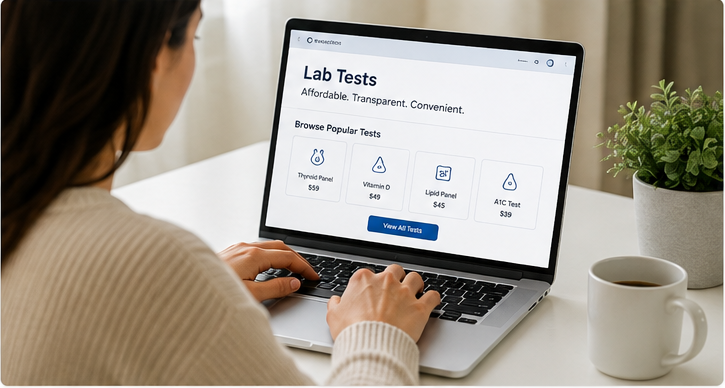
Lab 1: Browse Available Lab Tests & Prices →
Lab 2: Browse Available Lab Tests & Prices →
Affiliate link: PharmDecoded may earn a commission if you purchase through this link, at no additional cost to you. You are not required to use this service. Compare your available options before purchasing.
Before ordering, check:
- Whether the test is available where you live
- The total price
- Whether specimen collection is included
- How the required laboratory order is handled
- Where the sample will be collected
- How results are delivered
- Who you’ll contact if you have questions about the results
Self-Pay Testing: Pros and Limitations
Potential Advantages
- Upfront pricing
- No insurance may be required
- Convenient online ordering
- Ability to compare testing options
- Electronic access to results
Important Limitations
- You generally pay out of pocket.
- Insurance reimbursement isn’t guaranteed.
- Results may not automatically enter your medical record.
- State requirements can differ.
- An abnormal result may require additional medical evaluation.
- Ordering more tests isn’t automatically better.
Is the Laboratory Regulated?
Clinical laboratories performing human diagnostic testing in the United States are generally subject to federal Clinical Laboratory Improvement Amendments (CLIA) requirements.
CLIA establishes laboratory quality standards.
However, there is an important distinction:
CLIA regulates laboratory testing quality. It does not mean every available test is medically necessary for every person.
Ordering requirements can also differ based on state law and the type of testing involved.
The Bottom Line
If your doctor says no to a laboratory test, don’t assume the conversation is over.
Start with:
“Why don’t you recommend this test?”
Depending on the answer, your options may include:
- Discussing the reason with your doctor
- Asking about self-pay pricing
- Getting a second medical opinion
- Comparing eligible self-pay laboratory services
Self-ordered testing can provide another way to access health information.
But the safest approach is to keep the results connected to appropriate healthcare.
Get the information when it makes sense—but don’t let a laboratory number become your own diagnosis.
Frequently Asked Questions
Can I get blood work without insurance?
Yes. Many laboratories offer self-pay options. Some online laboratory services also provide cash-pay testing.
Can I order my own blood test?
Certain tests may be available through direct-access or self-pay services, depending on the test and state requirements.
Can I pay cash if my insurance doesn’t cover a test?
Possibly. Ask your healthcare provider and laboratory whether self-pay testing is available and what the total price will be.
Does an abnormal result mean I have a disease?
No. A laboratory result alone usually isn’t enough to establish a diagnosis. Results need appropriate interpretation.
Are more blood tests better?
Not necessarily. Testing is most useful when there is a reasonable reason for ordering it and a plan for what to do with the results.
Affiliate Disclosure: Some links on PharmDecoded are affiliate links. We may receive compensation if you make a purchase through them, at no additional cost to you. Affiliate relationships do not replace your own comparison of available healthcare options.
Medical Disclaimer: PharmDecoded provides general educational information and does not provide medical diagnosis, treatment, or individualized medical advice. Consult an appropriate licensed healthcare professional regarding symptoms, testing decisions, medications, or laboratory results.
Thank you for reading article: Doctor Won’t Order Labs? What Your Options Actually Are.