
When you pick up a prescription, the label can look like a wall of names, numbers, dates, and abbreviations.
Most of it, you can skim. A few parts you should check every single time.
This guide walks through every section of a standard pharmacy label — what each number means, where to find your prescription number, what the directions are actually telling you, and when something on the label is worth a phone call.
Affiliate disclosure: This article may contain affiliate links. If you purchase a product through one of these links, we may earn a commission at no additional cost to you. Our educational content and product recommendations are not influenced by the availability of a commission.
Medical disclaimer: This article is for general educational purposes only and is not medical advice. Prescription label formats and requirements can vary by medication, pharmacy, and jurisdiction. Always follow the directions provided with your own prescription. If anything on your label is unclear, contact your pharmacist or prescriber before taking the medication.
When you pick up a prescription, the label can look like a wall of names, numbers, dates, and abbreviations.
But a few pieces of it deserve your attention every single time.
A prescription container label is one of the main ways patients receive instructions for using their medicine safely. USP’s prescription-container labeling standards emphasize presenting information in a way patients can actually understand and use.
Here’s how to read the most common sections.
1. Pharmacy Information
Most labels identify the pharmacy that filled the prescription and how to reach them.
Keep that number handy if:
- the directions are unclear
- your medication looks different from your last refill
- you have a question about storage
- you think the quantity is wrong
- you’re experiencing a possible medication problem
- you need refill information
Your pharmacist can also tell you whether a change in appearance is just a different generic manufacturer. MedlinePlus recommends contacting the pharmacy or your provider any time a medicine looks unfamiliar.
2. Prescription (Rx) Number
The Rx number is the pharmacy’s own identifier for your prescription. It’s different from the drug’s NDC number.
Having it ready when you call speeds things up. MedlinePlus specifically recommends giving your name, Rx number, and medication name when requesting a refill.
Practical tip: keep the bottle nearby when you call instead of trying to recall the details from memory.
How to Find Your Prescription Number (Rx Number) on the Bottle
If you just need the Rx number and nothing else, here’s where to look.
On a standard pharmacy label, the prescription number is usually:
- Near the top of the label, often directly under the pharmacy’s name and phone number
- Labeled as “Rx”, “Rx #”, “RX NO”, “Prescription #”, or sometimes just “NO”
- Typically 6 to 8 digits, sometimes with a dash or a suffix (for example,
1234567-90) - Often printed in larger or bold type than the surrounding text, because pharmacy staff need to read it quickly
If you can’t find it on the bottle:
- Check the paperwork stapled to the bag — the Rx number appears on the receipt and information sheet too
- Check your pharmacy’s app or online account, where prescriptions are listed by number
- Check a prior refill’s label if you still have the old bottle
What it is not: the Rx number isn’t the same as the NDC number, the prescriber’s DEA number, or your insurance member ID. It’s just your pharmacy’s internal file number for that specific prescription.
Why you’d need it: requesting a refill by phone or app, transferring a prescription to another pharmacy, or asking a question about a specific fill. Having it ready makes every one of those calls faster.
3. Patient Name
Obvious, but check it first.
Before taking a newly filled medication, confirm the name on the bottle is yours — or the person it’s actually intended for.
Also check the medication name, strength, directions, and dosage form (tablet, capsule, liquid, cream, injection).
MedlinePlus recommends checking all of this — name, medication, dose, and directions — every time you pick up a prescription.
If something doesn’t match what you expected, don’t guess. Call the pharmacy before taking it.
4. Medication Name and Strength
Your label identifies both the drug and its strength — for example, Amoxicillin 500 mg capsules.
Strength tells you how much active drug is in each dose. Pay attention to it even when the drug name looks the same:
- Drug X 5 mg
- Drug X 10 mg
- Drug X 20 mg
These are not interchangeable just because the name matches. If the strength looks different than expected, call before taking it.
5. Directions for Use — the “Sig”
This is one of the most important parts of the label. You might see something like: Take 1 tablet by mouth twice daily.
In pharmacy practice, these directions are called the sig. Don’t rely on what you remember from your last bottle — read it fresh every time, since a dose or frequency can change between refills.
Watch for wording like:
- Daily — usually once a day
- Twice daily — two times a day
- Every 8 hours — based on roughly an 8-hour interval, not “whenever convenient”
- As needed — only under the specific circumstances your prescription describes
- With food / on an empty stomach — can matter a lot for certain drugs
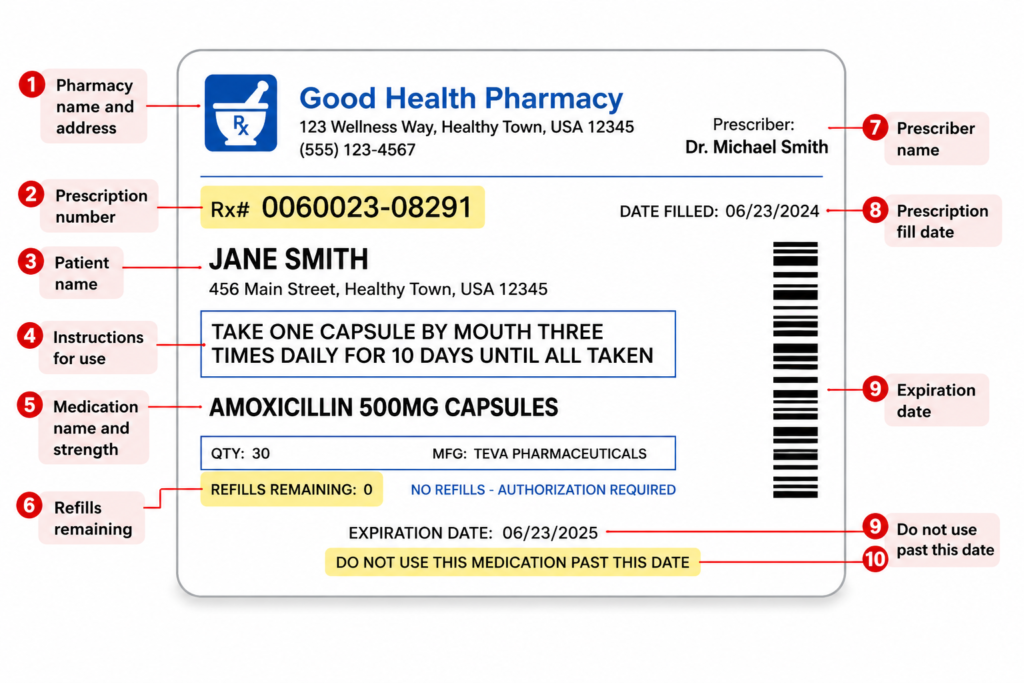
If you’re unsure how to interpret your directions, ask the pharmacist — don’t try to translate them yourself.
6. Quantity
This tells you how much was dispensed — 30 tablets, 90 capsules, 150 mL, 1 inhaler.
Quantity alone doesn’t tell you how many days it should last — that depends on your directions. Sixty tablets at “one tablet twice daily” is 30 days. But as-needed dosing makes this harder to predict.
7. Days Supply
Some labels or paperwork show a days supply — how long the dispensed amount should last at the prescribed directions.
Not every pharmacy prints this in the same place, or even on the bottle itself. If you think you’ll run out sooner than expected, call the pharmacy — there may be a simple explanation, but it’s better to sort it out before you’re actually out.
Never change your dose just to stretch a prescription further.
8. Refills Remaining
You’ll see something like “Refills: 3” or “No refills remaining.”
This isn’t a guarantee that a refill can happen immediately — other things can affect that, including prescription expiration, drug-specific rules, insurance limits, timing of your last fill, and additional authorization requirements.
If you see 0 refills on something you take regularly, contact your pharmacy or prescriber before you run out.
9. Prescriber Information
Your label identifies the clinician who wrote the prescription — useful if you see multiple providers.
If you don’t recognize the name, or didn’t expect a prescription from that person, ask the pharmacy to verify it.
10. Date Filled
This is when the pharmacy dispensed it — not an expiration or “use by” date. Useful for tracking your medication history or discussing a previous fill.
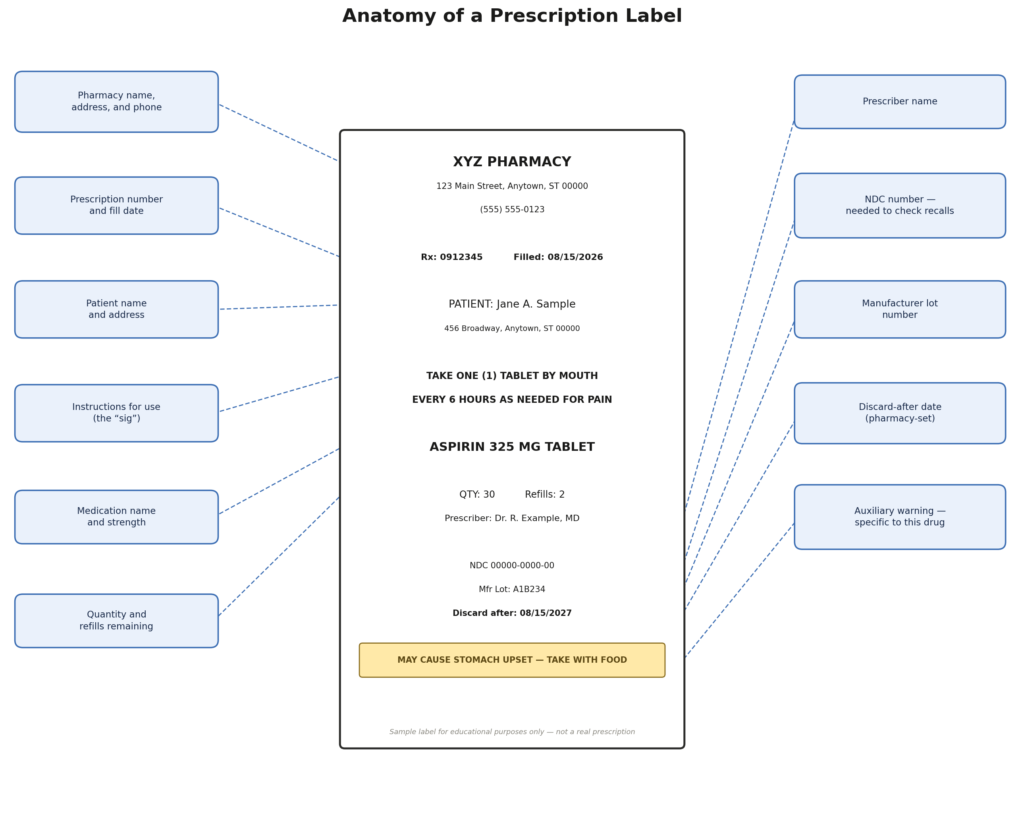
11. NDC Number: Useful, But It May Not Be on Your Bottle
The NDC (National Drug Code) identifies the labeler, product, and package size, per the FDA’s system.
Your pharmacy’s Rx number and the drug’s NDC are two different things — and the NDC isn’t always printed on your patient-facing label. If you need it, your pharmacy can look it up.
On recalls: NDC can help distinguish products, but recalls are frequently lot-specific. The FDA advises comparing your medication’s lot number against the affected lots listed in a recall notice — don’t assume you’re affected just because the drug name matches.
12. Manufacturer Information
Generic medications can come from different manufacturers, meaning two legitimate versions of the same drug may look different — shape, color, markings, packaging.
A change in appearance doesn’t automatically mean something’s wrong. MedlinePlus notes this is often just a different generic or brand — but still recommends checking with your pharmacy when something looks unfamiliar.
Never identify a medication solely by its color or shape.
13. Lot Number
A manufacturer’s lot number identifies a specific production batch — important during recalls, since FDA recall notices commonly cite specific lots.
It may not be printed on your pharmacy label, but that doesn’t mean it can’t be traced. If a recall happens, call the pharmacy — they can check whether what they dispensed you is affected.
14. Expiration, “Use By,” or “Discard After” Date
This deserves careful wording, because different labels mean different things depending on the medication, pharmacy, applicable standards, and jurisdiction.
This date isn’t necessarily the same as the manufacturer’s original expiration date on their stock package.
More importantly: don’t assume a medication is still safe or effective after the date on your label. Found an old prescription and thinking about using it? Ask your pharmacist first.
15. Auxiliary Warning Labels
Those small stickers — “may cause drowsiness,” “take with food,” “shake well,” “refrigerate,” “avoid prolonged sunlight,” “for external use only” — carry real safety information, but they’re not a complete list of everything you should know.
Some prescriptions also come with FDA-approved Medication Guides or Patient Package Inserts. Not every drug has the same type of labeling. Read everything you’re given, and ask about anything you don’t understand.
Watch for Easily Misread Directions
Prescription directions can look similar but mean very different things. Once daily, once weekly, once monthly, and twice daily are not interchangeable. Strengths can be misread too — vitamin D 50,000 IU is ten times stronger than 5,000 IU, and is often prescribed on a completely different schedule.
Check the strength, dose, and frequency on every single refill. If anything looks different than what you expected, call before taking it.
A 20-Second Prescription Label Check
Before you leave the pharmacy — or before taking a delivered prescription — check these five things:
- Is this for the correct person? Check the patient name.
- Is it the medication I expected? Check the drug name.
- Is the strength correct? Don’t assume just because the tablet looks familiar.
- Do I understand exactly how to take it? Read the directions.
- Does anything look different or unexpected? If yes, ask before taking it.
This simple habit does more for you than trying to memorize every number on the bottle.
Useful Medication-Organization Tools
Affiliate disclosure: This section may contain commission-earning links. If you make a purchase through one of these links, we may receive compensation at no additional cost to you. Choose products based on your individual needs — not because they appear on this page.
Weekly Pill Organizer A pill organizer can make it easier to keep track of scheduled medications. MedlinePlus lists these as one option for medication organization. [View recommended weekly pill organizers – Affiliate Link]
Before transferring medication out of its original container, ask your pharmacist if you’re unsure whether it needs special storage or packaging.
Medication Lock Box A lockable storage box can help keep medication secured away from children or others in the household. MedlinePlus recommends storing medicine securely and out of children’s reach and sight. [View medication storage boxes – Affiliate Link]
Medication Log or Tracker A simple medication list can help you record the name, strength, dose, schedule, prescriber, and notes for each medication. MedlinePlus recommends keeping a medicine record and reviewing it with your healthcare team. [View medication journals and trackers – Affiliate Link]
These products are organizational aids. They are not intended to diagnose, treat, cure, or prevent a medical condition.
One Thing You Shouldn’t Do
Don’t make a medication decision based only on an article, search result, product page, social media post, or AI-generated answer.
Your prescription was written for you specifically. If your label conflicts with what you believe your doctor told you — or the instructions simply don’t make sense — contact your pharmacist or prescriber before changing how you take it.
Common Questions About Prescription Labels
Where is the prescription number on a pill bottle?
Usually near the top of the label, beneath the pharmacy name and phone number, marked as “Rx,” “Rx #,” or “NO.” It’s typically 6 to 8 digits and often printed in bolder type than the text around it.
Is the Rx number the same as the NDC number?
No. The Rx number is your pharmacy’s internal identifier for your specific prescription. The NDC (National Drug Code) identifies the drug product itself — the labeler, product, and package size. Different purposes entirely.
What does “sig” mean on a prescription?
Sig is short for the Latin signetur, meaning “let it be labeled.” It refers to the directions for use — the part of the label telling you how much to take and how often.
What does DAW mean on a prescription label?
DAW stands for “Dispense As Written.” It signals that the prescriber wants the specific product named on the prescription, and that the pharmacist should not substitute a generic.
Does the discard date mean the medication is unsafe after that date?
Not automatically — but don’t assume it’s fine either. The discard-after date on a pharmacy label isn’t necessarily the same as the manufacturer’s expiration date on the original stock bottle. If you find an older prescription and are considering using it, ask your pharmacist first.
Why does my medication look different than last time?
Most often because it came from a different generic manufacturer. Same active ingredient and strength, different shape, color, or markings. It’s usually nothing — but check with your pharmacy any time a medication looks unfamiliar, and never identify a medication by appearance alone.
Where do I find the lot number for a recall?
The manufacturer’s lot number may not be printed on your pharmacy label at all. If a recall affects one of your medications, call the dispensing pharmacy — they can check whether the specific product they gave you is affected.
The Bottom Line
A prescription label is more than a sticker on a bottle. At minimum, learn to check:
Your name → Medication → Strength → Directions → Quantity → Refills → Important dates → Pharmacy information
Those checkpoints help you catch something unexpected and know what to ask.
You don’t need to become a pharmacy expert. You just need to know what to check — and when to ask for help.
References
U.S. Food and Drug Administration — National Drug Code Directory and NDC background information
- U.S. Food and Drug Administration — Understanding Drug Recalls: What to Know and What to Do
- United States Pharmacopeia — General Chapter <17>, Prescription Container Labeling
- MedlinePlus — Medicine Safety: Filling Your Prescription
- MedlinePlus — Keeping Your Medicines Organized
Last updated 8/20/2026
Questions about something printed on your prescription label? Contact your dispensing pharmacist for medication-specific guidance.