
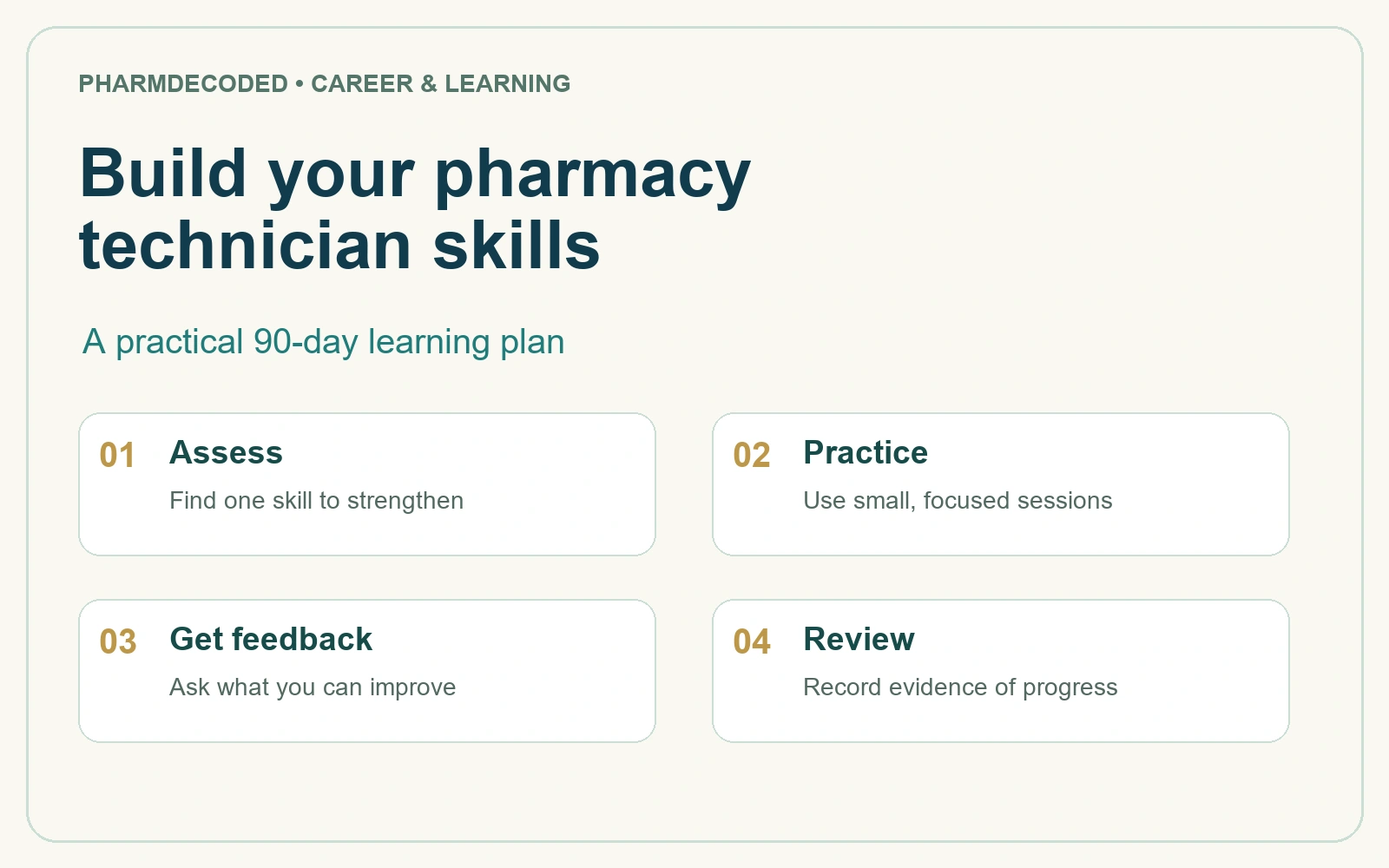
Pharmacy technician skills develop through careful practice, useful feedback and a habit of checking what you do not yet understand. A long list of topics can feel overwhelming. Start by choosing one skill you can describe, practice and measure.
This guide gives you a free self-assessment, an example learning goal and a flexible 90-day plan. It is useful for organizing study or a conversation with a workplace trainer. It does not authorize new duties or replace required training.
Commercial disclosure: PharmDecoded promotes paid DailyLotusPrints digital downloads in this article. The free activities below do not require a purchase. Check Etsy for current prices, exact contents and license terms.
The Day Maya Stopped Trying to Know Everything
A fictional story inspired by the practical lessons in the DailyLotusPrints skills guide.
On her first morning in the pharmacy, Maya kept thinking, What if someone asks me something I don’t know?
Perhaps you’ve felt that too—the pressure to remember every medication name, calculation and procedure before you feel ready.
Her trainer offered a different starting point: “Build dependable habits. Ask questions. Learn one skill at a time.”
During a practice session, Maya faced a simple conversion: How many milligrams are in 0.5 grams?
Would you multiply or divide?
Maya wrote the units before reaching for her calculator:
0.5 g × 1,000 mg/g = 500 mg.
Then she checked her reasoning. Milligrams are smaller units, so the number should become larger. Writing the units helped her see why the answer made sense.
Later, an unclear instruction made her hesitate.
Would you guess if you thought you knew what it meant?
Maya almost did. Instead, she asked for clarification through the pharmacy’s approved process. She was beginning to understand that accuracy includes knowing when to pause.
At the counter, a frustrated customer interrupted her explanation.
“What should I say now?” she wondered.
She remembered the book’s HEARD approach: hear the person out, empathize, apologize sincerely for the experience, resolve what you can or explain the next step, and afterward examine what caused the problem.
Maya listened first. She explained what she could check and brought in the pharmacist when the conversation needed clinical guidance.
That evening, she opened the skills self-assessment in Key Skills for Pharmacy Technicians.
If you were sitting beside her, which skill would you choose to strengthen first?
Maya chose calculations. On her 90-day worksheet, she replaced “Get better at math” with a specific action: complete a small practice set each week, check the answers and record the reason for each mistake.
Her progress would be something she could show—not simply a feeling that she had studied enough.
She still had plenty to learn. But now she had a way forward.
You can start the same way: choose one skill, take one useful action, and return to it consistently.
The DailyLotusPrints skills guide brings together nine skill chapters, 15 practice problems with an answer key, and four printable worksheets to help you turn that intention into a plan.
What pharmacy technician skills should you develop?
The U.S. Bureau of Labor Statistics describes technicians working under pharmacist supervision and emphasizes qualities such as attention to detail, communication, customer service, organization and math. Your setting and training determine which tasks you perform.
Use these nine areas as a learning map, rather than a claim that every technician performs every activity:
- Medication knowledge: recognize names and terminology, and know which reference or pharmacist to consult.
- Pharmacy math: show units, organize calculations and check whether an answer makes sense.
- Safety and accuracy: identify missing or inconsistent information and follow established checking steps.
- Law and compliance: know where to verify the rules that apply to your role and location.
- Order entry and billing: understand the approved workflow and ask for help with unfamiliar issues.
- Inventory: follow workplace procedures for receiving, storage and documentation.
- People skills: listen, explain the next step clearly and refer clinical questions appropriately.
- Technology and data: learn your systems while protecting information and checking entries.
- Career development: plan learning, keep records and describe your experience honestly.
Start with a five-minute self-assessment
For each area, write one task you have practiced and one question you still have. Rate your learning confidence using this simple scale: 1 = unfamiliar, 2 = need guided practice, 3 = can explain with a reference, 4 = can explain consistently in a practice setting. This is a personal learning tool, not a competency assessment or permission to work independently.
| Skill | Evidence today | Next practice step |
|---|---|---|
| Math | I can convert units, but sometimes omit them | Show units on every line of five fictional problems |
| Communication | I explain the process but rush when interrupted | Rehearse a calm explanation with a trainer |
| Technology | I know the basic screen but not one exception | Ask for a demonstration in the approved training environment |
Choose the gap that matters most to your current learning goal. A low confidence score alone does not tell you where to begin; consider the task’s importance and ask your trainer what to prioritize.
Turn a broad goal into a useful practice habit
“Get better at math” is difficult to review. A clearer goal is: “For four weeks, complete five fictional quantity or days-supply exercises twice weekly. Write the units, check the answer and record why each error happened.” Your evidence is the completed work and an explanation of the method.
A short worked example
A fictional exercise provides 84 tablets with fixed directions of one tablet three times daily. Assume no dose changes, wastage or product-specific limitations. What is the theoretical days supply?
Answer: 1 tablet/dose × 3 doses/day = 3 tablets/day. Then 84 tablets ÷ 3 tablets/day = 28 days. Check by multiplying 28 days × 3 tablets/day = 84 tablets. This is a study example, not a dispensing instruction; variable directions and real prescriptions may require additional information.
Record the reason for a mistake, not just the score. “I counted doses but missed tablets per dose” tells you what to practice next. “I got it wrong” does not.
Your flexible 90-day development plan
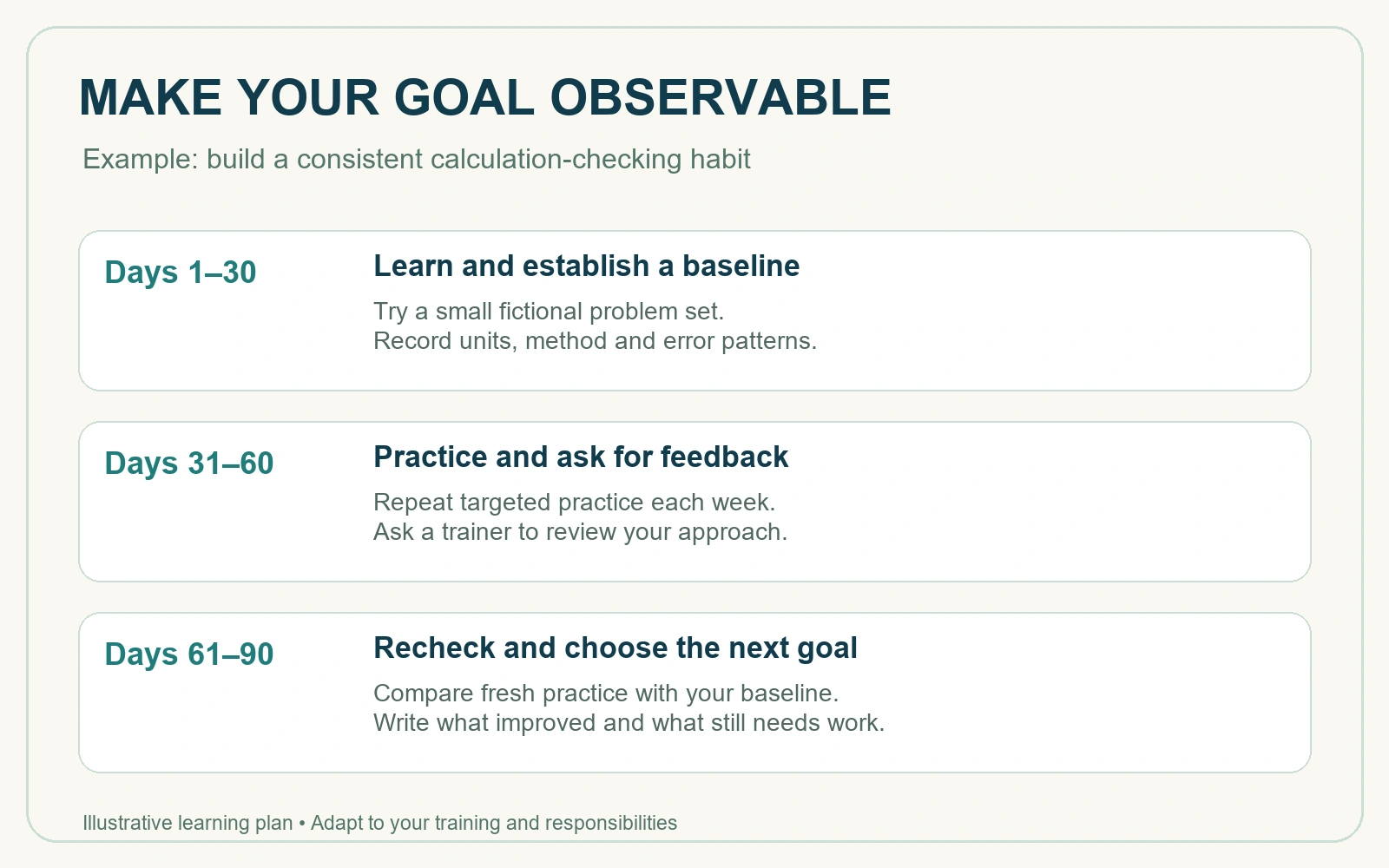
Days 1–30: establish a baseline
Choose one or two goals. Identify a current reference, a training resource and someone who can give feedback. Complete a small baseline exercise and save your work. Keep the plan realistic enough to repeat during a busy week.
Days 31–60: practice and request feedback
Use short sessions focused on your specific gaps. Ask a trainer to check your explanation or demonstrate a process you do not understand. Use fictional or approved training scenarios; do not copy patient details into a personal workbook.
Days 61–90: recheck and choose the next goal
Try fresh exercises or explain the process again. Compare with your baseline and write what improved. Note any areas still needing support. A completed calendar is not proof of readiness; follow your workplace’s formal competency process.
Keep career records accurate
Keep a private record of completed learning, dates, feedback and relevant certificates. When preparing a resume, use your own verified experience and results. Do not copy sample achievements as if you performed them.
Certification and state authorization are separate matters. Check the current PTCB CPhT requirements if that credential fits your goal, and consult your state board for requirements affecting practice. PTCB’s state-regulation resource is a starting point for locating the appropriate board. This article and workbook are not recognized training programs or official certification products.
Want the printable skills guide?
The DailyLotusPrints Key Skills for Pharmacy Technicians guide brings nine chapters, 15 practice problems with an answer key and four printable worksheets into one 35-page US Letter PDF. Use its self-assessment, 90-day plan, CE tracker and resume/interview worksheet to organize learning.
See the skills guide, previews and current price on Etsy →
The PDF is searchable and non-fillable; print it or annotate using compatible software. No physical book, certification, course or PharmDecoded Premium access is included. Math and medication topics also occur in the shop’s other resources, so compare contents and buy for a specific need.
Continue learning
If your next goal is exam preparation, use the four-week PTCE study plan and PTCE practice center. These provide a different focus from a career skills plan; neither a study schedule nor a purchase guarantees an exam result or job.
Common questions
Do I need to master all nine areas at once?
No. Start with your current training needs and a manageable goal. Some areas require specialized training and may not be part of your role.
Can I use the plan before getting a technician job?
Yes, for personal learning and preparing questions for a training program. It does not replace eligibility, training or registration requirements.
Is the workbook official PTCB material?
No. DailyLotusPrints and PharmDecoded are independent educational resources and are not affiliated with or endorsed by PTCB or NHA.
Educational use only; not medical, legal or professional advice. Verify workplace decisions with current references, applicable rules and pharmacist direction. Prepared with AI assistance; no clinical peer review is claimed. Sources checked October 11, 2026.