
Moving a prescription to a new pharmacy sounds simple. Call, ask, done. Most of the time, it is that simple. But the rule that controls how a prescription moves depends on what drug it is — and most patients have never heard the rule.
Here’s why this matters more than ever. Three separate reports, from three different organizations, point to the same thing: people are switching pharmacies more than they used to.
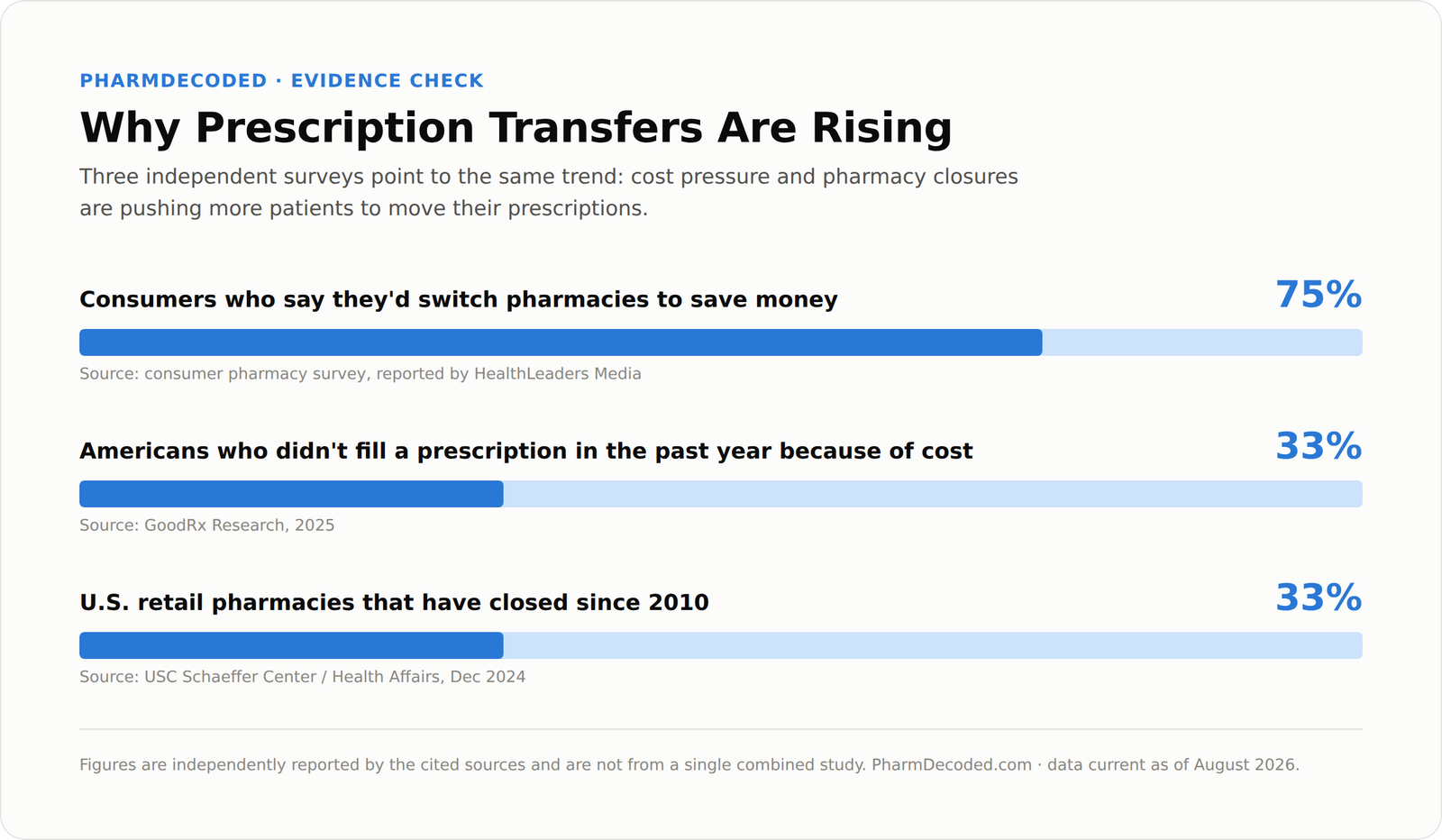
Nearly 1 in 3 U.S. retail pharmacies has closed since 2010, according to a December 2024 analysis from the USC Schaeffer Center published in Health Affairs. A third of Americans skipped filling a prescription in 2025 because of cost, per GoodRx’s own research. And in a separate consumer survey reported by HealthLeaders Media, three out of four people said they’d switch pharmacies just to save money.
Put those together, and a prescription transfer isn’t a rare event anymore. It’s routine. This guide walks through exactly how to do it, how long it takes, and the one legal detail that trips almost everyone up.
The 3-step process for a regular prescription
For most medications — blood pressure pills, cholesterol drugs, antibiotics, thyroid medication, anything that isn’t a controlled substance — transferring is genuinely this easy:
- Call or visit the new pharmacy. Tell them you want to transfer a prescription. Have the drug name, your date of birth, and if possible, the prescription (Rx) number from your old bottle label.
- Give them your old pharmacy’s name and phone number. The new pharmacy does the rest of the legwork.
- A pharmacist calls a pharmacist. By federal and state law, this call has to happen pharmacist-to-pharmacist (or a supervised pharmacy intern) — not clerk to clerk. That’s not a formality. It’s how the two pharmacies verify the prescription is real and how many refills are actually left.
Most transfers for non-controlled medications finish the same day. Some large chains (CVS-to-CVS, Walgreens-to-Walgreens) can do it almost instantly, because every store in the chain shares one live database — it’s less a “transfer” and more just pulling up your file at a different counter.
The rule most people don’t know — it depends on the drug
This is the part that generates the most confused phone calls to pharmacies. Not every prescription can move the same way, and it comes down to the DEA’s controlled-substance schedule.
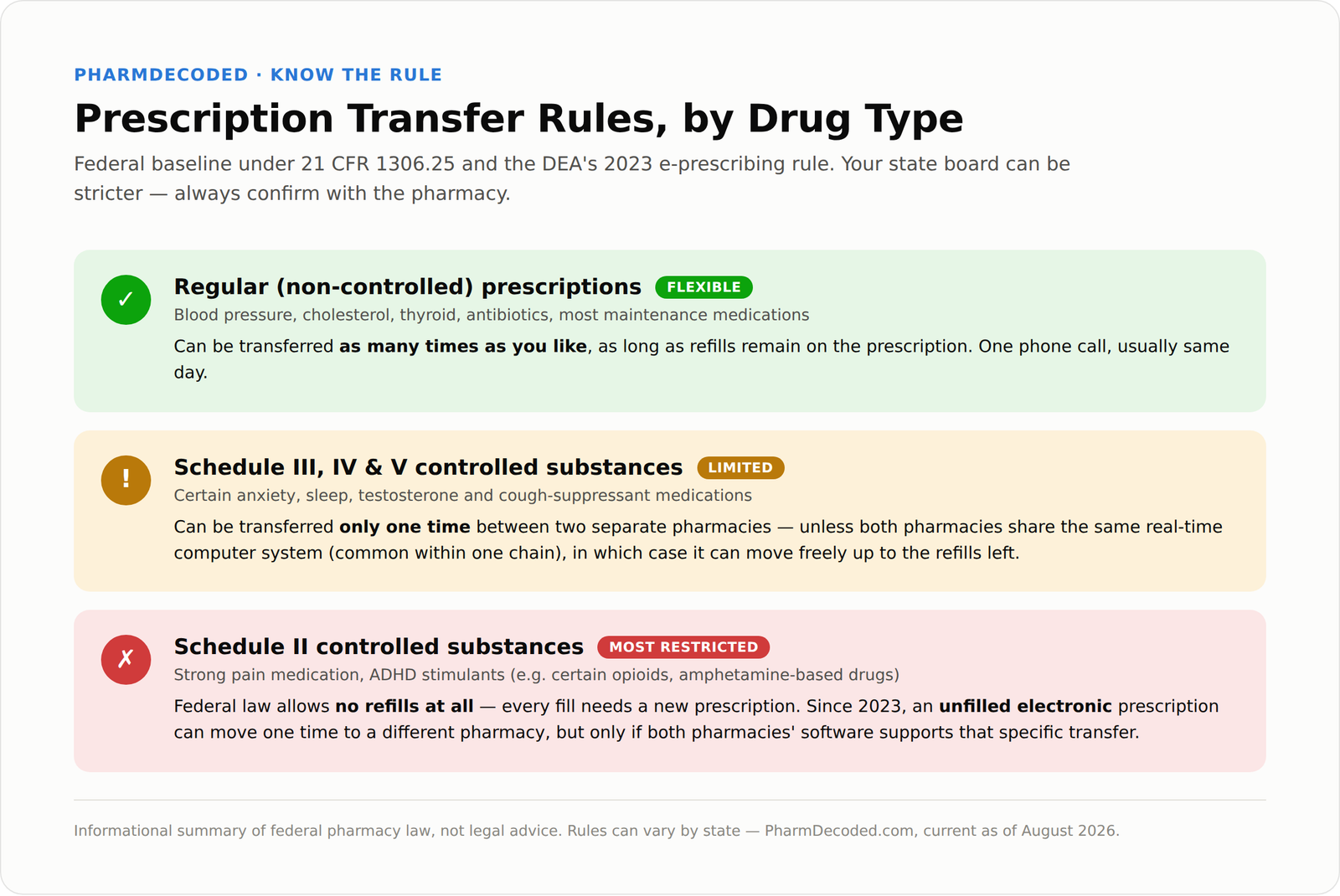
Regular prescriptions: unlimited transfers, for as long as refills remain. (Federal law does not restrict these — it’s state pharmacy law, and states are almost universally permissive here.)
Schedule III, IV, and V — think certain anti-anxiety medications, sleep aids, testosterone, some cough medicines with codeine — can legally transfer only once between two independent pharmacies, per 21 CFR § 1306.25. The one exception: pharmacies that share a real-time, online database (again, usually meaning the same chain) can transfer these back and forth as many times as refills allow, because the whole point of the one-transfer rule is preventing double-dispensing when no one can see the other pharmacy’s records.
Schedule II — strong pain medication, ADHD stimulants like certain amphetamine-based drugs — is the strictest category, and it works differently from the other two. Schedule II prescriptions never have refills, period. Every fill requires a brand-new prescription from the prescriber. What changed in 2023 is narrower than people assume: the DEA now allows the unfilled electronic prescription itself to be transferred one time to a different pharmacy, at the patient’s request — but only if both pharmacies’ e-prescribing software specifically supports it. Adoption of that capability is still uneven across the industry, so calling ahead to confirm is worth the two minutes.
None of this is legal advice — it’s a plain-English summary of the federal floor. Your state board of pharmacy can add stricter rules on top of it, so when in doubt, ask your pharmacist directly.
Why “my prescription won’t transfer” usually isn’t a legal problem
If a pharmacy tells you they “can’t” transfer a prescription, there are usually only two real reasons, and it’s worth knowing which one you’re actually running into:
- It’s a legal limit — the Schedule II/III-IV-V rules above, or the prescription is already expired / out of refills.
- It’s an insurance network issue — your plan’s pharmacy benefit manager (PBM) only covers certain pharmacies “in-network.” The prescription can legally move; your insurance just won’t pay full benefit at the new location. That’s a contract issue, not a DEA one. We break down how PBMs set these rules in our PBM explainer.
Knowing which one you’re dealing with saves you an argument at the counter — and tells you whether the fix is a phone call or a plan-year decision.
While you’re switching, it’s worth comparing the price
Since you already have to call around, this is the natural moment to check whether your new pharmacy is even the cheapest option for that specific drug — cash price and insurance copay can differ by a lot for the same medication at the same pharmacy. We compare the major discount-card programs on our Deals page.
FAQ
Can a pharmacy refuse to transfer my prescription?
No — a pharmacy cannot legally refuse to transfer a valid, active prescription just because you’re leaving. They can (and by law, generally must) complete the transfer once you ask, unless the prescription itself is expired, out of refills, or falls under Schedule II.
Does transferring cost anything?
No. Transferring a prescription between pharmacies is free. You may pay a different price for the medication itself once it’s filled at the new pharmacy, but the transfer itself has no fee.
How long does a prescription transfer take?
For non-controlled medications, usually same-day — often within an hour if the new pharmacy isn’t busy. Within the same chain, it can be near-instant. Controlled-substance transfers can take longer since they require a direct pharmacist-to-pharmacist call and more documentation.
Can I transfer a prescription to a mail-order pharmacy?
Yes, generally, following the same schedule-based rules above. See our mail-order vs. retail comparison for the tradeoffs.
Sources
- 21 CFR § 1306.25 — Transfer between pharmacies of prescription information for Schedules III, IV, and V controlled substances
- DEA: Revised Regulation Allows Pharmacies to Transfer Electronic Prescriptions (2023)
- Federal Register: Transfer of Electronic Prescriptions for Schedules II-V Controlled Substances
- USC Schaeffer Center / Health Affairs — Nearly 1 in 3 Retail Pharmacies Have Closed Since 2010
- GoodRx Research — A Third of Americans Don’t Fill Prescriptions Due to Cost
- HealthLeaders Media — Nearly 75% of Consumers Would Change Pharmacies for Savings