
Preparing for the Pharmacy Technician Certification Exam can feel like trying to learn everything at once. A better starting point is a repeatable routine: study one topic, answer questions without your notes, explain your mistakes and return to that topic later.
This four-week PTCE study plan gives you a practical way to organize that routine. It includes five short pharmacy-math exercises, a medication-review template and a simple error log you can copy today. Four weeks is a planning example, not a promise that every learner will be ready in a month. Extend the schedule if you need more time.
Commercial disclosure: This article includes links promoting the DailyLotusPrints pharmacy technician study book and digital study resources on Etsy. Those downloads are paid products. You can use the study plan and exercises below without buying anything.
Start with the current PTCE outline
The PTCB content outline effective January 6, 2026 organizes the exam into four domains:
| Domain | Share of exam content |
|---|---|
| Medications | 35% |
| Federal Requirements | 18.75% |
| Patient Safety and Quality Assurance | 23.75% |
| Order Entry and Processing | 22.5% |
Use this outline to check your coverage, then spend extra time on your weakest subjects. Your personal study-time split does not need to match these percentages exactly.
Begin with a short diagnostic. Write down both wrong answers and answers you guessed correctly. A lucky guess is still a topic to revisit. If you prefer browser-based practice, start at the PharmDecoded PTCE practice center.
Week 1: Build a medication-review habit
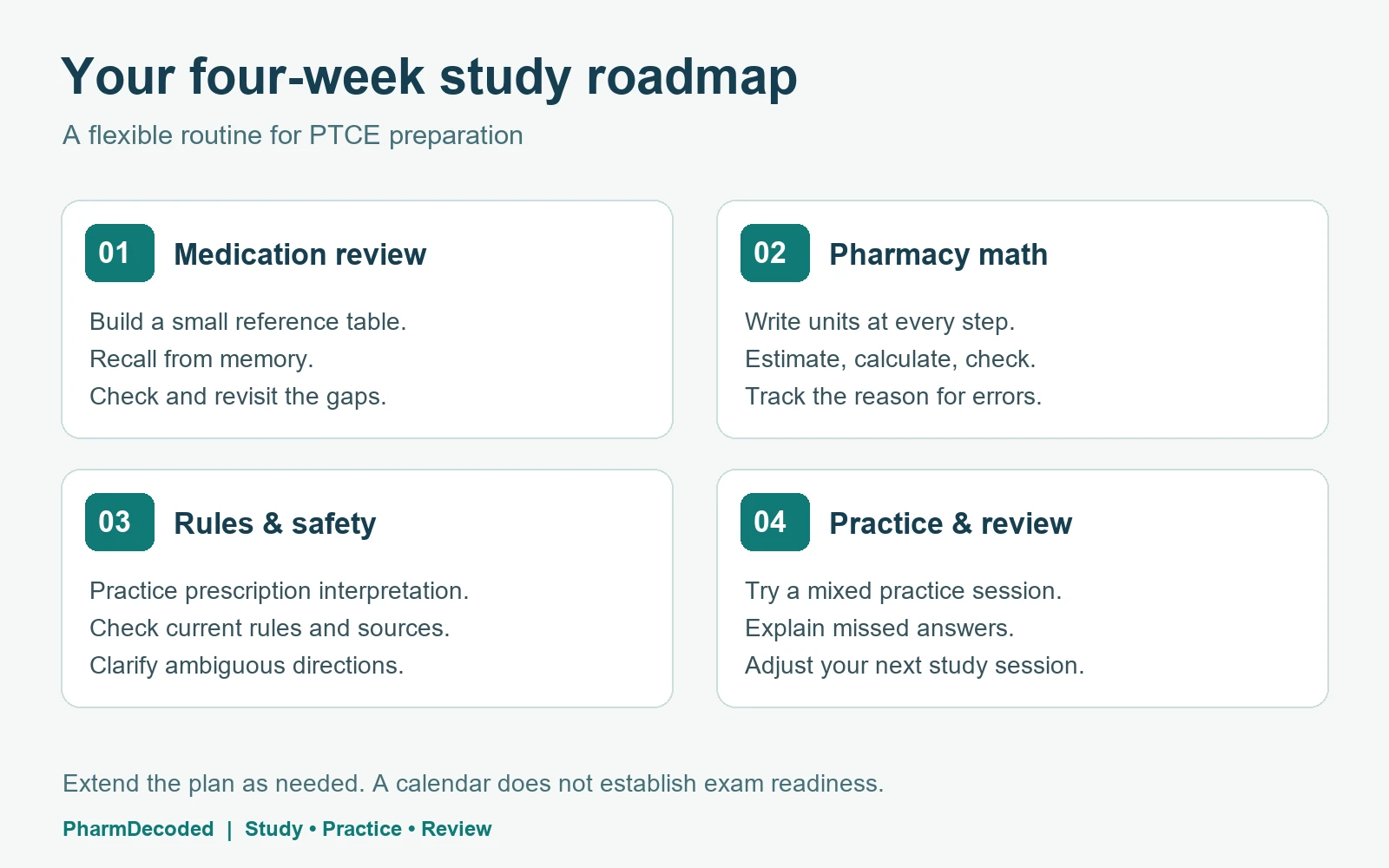
Pick a manageable group of medicines for each session. Build a small table with these columns: generic name, brand example, class, common use, and a caution or storage point to verify. Add the source and date you checked it. Names alone are a starting point; aim to explain how related medicines differ.
Use a blank sheet for recall. Cover your reference, fill in the table from memory, then check it. Mark the missing information rather than rereading the whole page. Revisit those gaps the next day and again later in the week.
Suggested daily session: 15 minutes building a small reference, 10 minutes recalling yesterday’s material, and 10 minutes answering questions. Use current authoritative references for medication facts and seek pharmacist guidance when a real-world question needs clinical judgment.
Week 2: Make pharmacy math a daily practice
Write the units at every step. Before calculating, identify what the question asks for: tablets, milliliters, days or concentration. Estimate the answer’s size, calculate, then check whether the final unit makes sense.
Try these five original exercises. They use fictional study scenarios and are not instructions for dosing a real patient.
1. Convert grams to milligrams
Convert 0.75 g to mg.
Worked answer: 0.75 g × 1,000 mg/g = 750 mg. The gram units cancel. Multiplying by 1,000 makes sense because a milligram is a smaller unit.
2. Calculate a tablet quantity
A fictional exercise specifies two tablets per dose, twice daily, for 15 days. How many tablets are needed?
Worked answer: 2 tablets/dose × 2 doses/day × 15 days = 60 tablets. “Twice daily” describes the number of doses, not the number of tablets in each dose.
3. Calculate theoretical days supply
A fictional prescription provides 120 tablets, with a fixed direction of one tablet four times daily. Assume no dose changes, wastage or additional package constraints.
Worked answer: 1 tablet/dose × 4 doses/day = 4 tablets/day. Then 120 tablets ÷ 4 tablets/day = 30 days. As-needed directions, titration and product-specific limits require additional information; do not apply this simple answer to them automatically.
4. Calculate a liquid volume
In a fictional calculation, a liquid contains 120 mg in 5 mL. What volume contains 360 mg?
Worked answer: 360 mg × 5 mL/120 mg = 15 mL. Check: 360 mg is three times 120 mg, so the volume is three times 5 mL.
5. Interpret a percentage concentration
What does 1% weight/volume mean in mg/mL?
Worked answer: 1% w/v means 1 g per 100 mL of final solution. That is 1,000 mg ÷ 100 mL = 10 mg/mL. The w/v label matters: do not treat all percentage expressions as interchangeable.
After each session, record the reason for an error: wrong conversion, missed frequency, confused concentration, incorrect setup or arithmetic. Your next practice session should address that specific reason.
Week 3: Connect rules, safety and prescription interpretation
Turn each unfamiliar topic into a question you can explain in plain English. What information is missing? What reference would you consult? When should the issue be brought to a pharmacist?
For pharmacy SIG codes, practice recognizing terms and translating complete fictional directions. Recognition does not authorize guessing unclear instructions. Use the prescription-label guide for an additional introduction to reading medication directions.
For legal topics, make a reference card with the rule, jurisdiction, source and date checked. Federal requirements and state requirements need separate attention. Avoid memorizing an undated chart as if it settles every real dispensing situation.
Finish the week with mixed questions. Switching between topics helps you notice whether you understand the problem or are simply repeating the method used in the previous exercise.
Week 4: Practice, review and adjust
Take a longer practice session under consistent conditions. Record how much time you used and which questions you skipped or guessed. Afterward, spend a separate session reviewing the explanations.
For each missed question, write one sentence explaining why your answer failed. Then solve a fresh question on the same topic. Repeating the identical question until you remember its letter is weaker evidence of understanding.
Use this error-log format:
| Topic | My mistake | Correct method or source | Next review |
|---|---|---|---|
| Days supply | Counted doses instead of tablets per day | Find units per day first, then divide quantity | Tomorrow |
| Medication review | Confused two classes | Compare their class and use using a current reference | In three days |
| Prescription interpretation | Assumed missing directions | Identify the ambiguity and seek clarification | Next mixed session |
Practice percentages are feedback, not an official scaled score or a guarantee of passing. Check eligibility, scheduling and exam information directly with PTCB.
Want a printable companion for this plan?
The DailyLotusPrints Pharmacy Technician Study Book on Etsy brings structured lessons, pharmacy calculations, medication review and practice questions into a downloadable PDF. It includes a 90-question practice exam and review resources for organizing study sessions.
Use it as a companion to the official outline: choose a chapter, attempt the exercises, check the explanations and bring your weak topics back into the following week’s plan. Open the listing to review its page previews, exact contents, current price and personal-use terms before buying. This is a digital download; no printed book is shipped.
See the study book and download details on Etsy →
If you only need extra math practice, compare the 100-question pharmacy math workbook or 40-problem calculation workbook. For a compact reference, consider the SIG-code charts. Buy for a specific study need; compare topics and included files before purchasing several resources. The math workbook’s print and 6×9 editions contain the same questions in different layouts.
Questions before you start
Is four weeks enough for PTCE preparation?
It depends on your starting knowledge, available time and practice results. Repeat a week or extend the plan when you cannot explain the material confidently. A calendar does not establish exam readiness.
Should I memorize a drug list or practice calculations first?
Work on both in small sessions. Use diagnostic results to decide where additional time will help most. Include safety and federal requirements so your preparation does not narrow to only names and math.
Does buying the book unlock PharmDecoded Premium?
The Etsy purchase is a separate PDF download. It does not include access to PharmDecoded’s online Premium practice library. Check each product’s current terms for what is included.
Is this official PTCB material?
No. The article and DailyLotusPrints downloads are independent educational resources, not affiliated with or endorsed by PTCB. Practice questions are simulations, not actual exam questions. No exam outcome is guaranteed.
Educational use only; not medical, legal or professional advice. Verify real medication and workplace decisions with current authoritative references and pharmacist direction. This article was prepared with AI assistance. Official-outline facts checked October 11, 2026; no clinical peer review is claimed.